GD&T Advanced Applications and Tolerance Stacks

Course Materials
The course follows along with the GeoTol Applications and Tolerance Stacks Workbook that contain student exercises.

GD&T Applications and Tolerance Stacks

2.5-Days (20 Hours)

Course Description: This is an advanced level design course for GD&T application and stack up analysis. It includes case-study part drawings as exercises for selecting datum features and applying tolerances. It teaches how to perform tolerance stack loops and analysis across multiple-part assemblies.

Prerequisite: GeoTol Pro GD&T Core Concepts Course

 Course Objectives:

  • Proper selection of functional datum features
  • Apply appropriate tolerance symbols and calculate tolerance values for functional requirements
  • Perform tolerance stack loops and transfer data to tables
  • Able to reallocate tolerances to meet manufacturing capabilities
  • Know differences between worst case analysis and statistical methods (RSS and MRSS)

Targeted Audience: Anyone who needs to author an engineering drawing or do tolerance analysis: personnel in design, or high-level manufacturing and quality

Content Covered: Level 1 core content (16 hours) + select content from Level 2

The combined content from both levels creates the customized course. See below for detailed course content.
Course Highlights:

The GD&T Applications and Tolerance Stacks course goes beyond the symbol and concept definitions in ASME Y14.5 with a series of case-study inspired problems. Most of the class is exercises for students with the instructor giving guidance and tips for an optimized tolerancing scheme.

  • Course has been refined for over 30+ years by experts at GeoTol that write the ASME standards
  • Each student receives the GeoTol Applications and Tolerance Stacks workbook
  • 3D printed plastic models used for demonstration of part fitting
  • Learn tolerance stack methods and GD&T application in the same course
  • Beyond the theory with relatable examples and practical student exercises
  • Customizable content for focused training
  • Company drawings may be used during the training

Beyond the Standards

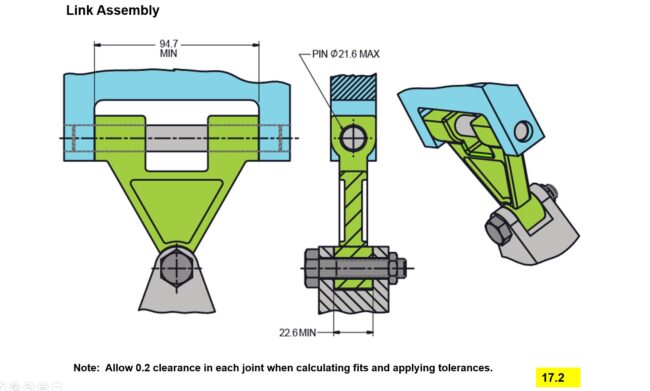
Engineering drawing with design symbols of a link assembly

Relatable Examples

This program goes beyond the theory in the Y14.5 standard with relatable examples to show practical uses of the symbols and concepts. This program has less lecture than the fundamentals with many practical exercises to generate effective discussions.

Example exercise for learning how to calculate seal squeeze stacks

Tolerance Stacks Method

There are many ways to conduct a tolerance stack up. This course shows many different methods for keeping track and displaying all those dimension and tolerance values. This makes it easy to show others your work-flow and to make a quick update to a project.

Customizable Courses

This program is customizable by altering lessons from the tolerance stack up and GD&T applications sections. Applications may be chosen based on the type of parts the audience normally designs.

Customizing the Program

This course combines tolerance stack up analysis with design GD&T applications. Lessons from the stacks section are alternated with the design applications to add variety to the program. Students also learn that proper application of GD&T can lead to simpler tolerance stack up and allow more tolerance for manufacturing.

Geometric tolerancing is used on a variety of applications from large parts to small parts, machined parts, sheet metal, composites, turned parts, castings, weldments, etc. and each of these applications may have its own special tolerancing treatments. The program leader may customize the training by skipping some examples and concentrate on more applicable lessons.

*Most common delivery is a 2.5-day (20-hour) course. Additional hours may be added to the course to cover more content.

Detailed course outline

Tolerance Stacks Units

  • Unit 1 Linear Stacks – Vector loop method with plus/minus tolerances
  • Unit 2 Linear Stacks with Profile – Profile stacks on single parts,
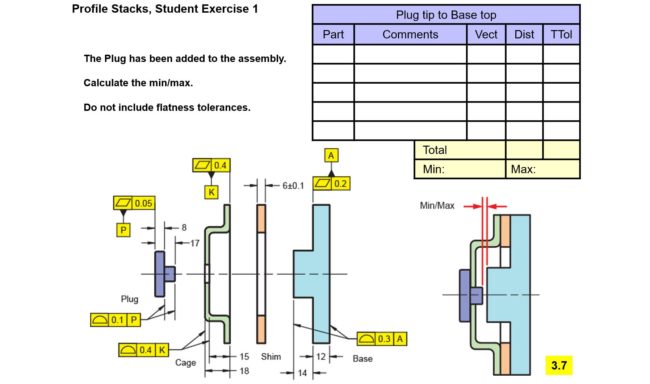
  • Unit 3 Profile stacks on assemblies
  • Unit 4 Axial Boundary Stacks – calculations of boundaries with position, runout and profile (MMB/LMB), Wall thickness calculations
  • Unit 5 Axial Boundary Stacks for Assemblies with Joints
  • Unit 6 Orientation Stacks – Parallelism, Perpendicularity, Angularity, Ratio calculations
  • Statistical Stack Methods – Worst case vs. RSS vs. MRSS

GD&T Applications Units

  • Introduction, Fixed and Floating Fastener Formulas – Calculating position
  • Grommet Assembly – 2 mill-machined parts with linear gap stack
  • Powder Case – 2 machined cylindrical parts with stack
  • Design Applications Advanced Concepts
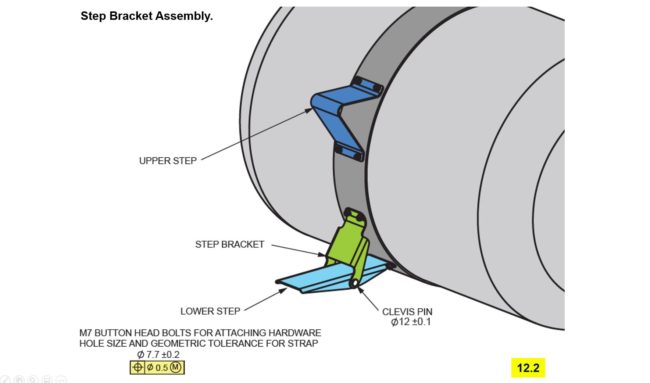
  • Step Bracket – 3 sheet metal parts, complex surfaces
  • Optic Connector – 2 cylindrical machined parts with stacks
  • Alternator Bracket – Inseparable welded assembly
  • Fuel Cooler Bracket – bent sheet metal part
  • Valve Assembly – 3 cylindrical machined parts with stack
  • Regulator Bracket – bent sheet metal part
  • Link Assembly – Casting and machined part drawings
  • Mixer Assembly – 7 machined parts with complex stacks­

Visit the GeoTol Store